|
Summer 2003
When I wrote my first letter to you some many years ago, I thought I
knew all about you that I was ever going to know. That makes how much I’ve
learned since then most amazing! Some of it has come in bits and pieces, but a
lot of it came in one large chunk. More on all that later and the many things
that have changed as a result of new information.
One thing that hasn’t changed from the first letter is wanting to tell
you about what a thrill it was to set foot inside your home in the summer of
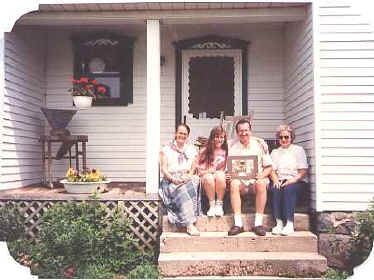
1992, to sit on your kitchen stoop, and to know that I was in the very rooms
where you and at least some of your dear babies died. I enjoy contemplating what
you would have thought if you could have known that, 110 years after you gave up
your earthly struggle, some of your descendants would not only be remembering
you but caring about you and your home and still visiting the graves of you and
George and your precious babies. I’m happy to report that the folks who now
live in the house care about it and are taking good care of it. Actually, it’s
quite magnificent from the outside with its white vinyl siding (What’s
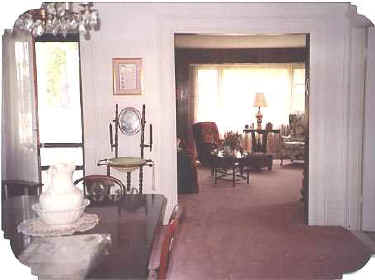
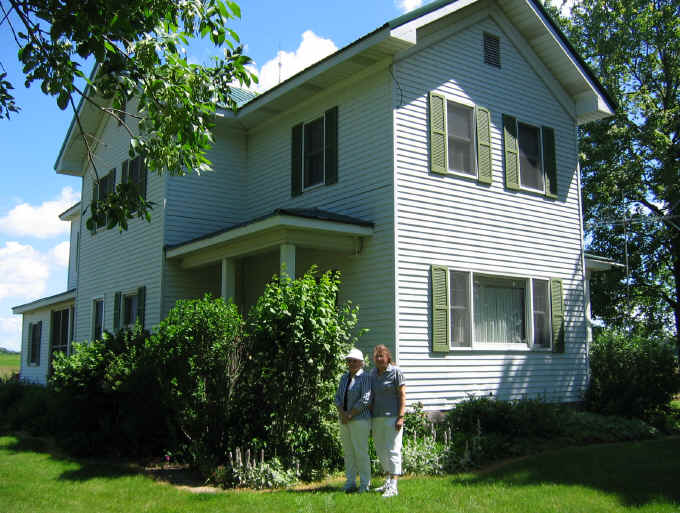
that? you wonder?), and very tastefully done inside. At the time of the first letter, we knew that you were born in Delaware
County, New York, but little else. I am touched, and I think you might be, too,
to know that we learned that because your husband’s second wife knew that
about much you and recorded it in a family history, forty years after your death
and fifteen after his. She is also the one who gave you a maiden name,
Champlain, and a middle initial, E. Mary Ann Porter was a remarkable and godly
woman—I know you’re grateful for that since God gave her the task of raising
your youngest son.. Family tradition told us that you came from a French heritage (the name
“Champlain” seemed to fit with that), and that the brown eyes in the family
(which your granddaughter Fern—my Grandma Hawkins—had) came from you, also
that you never fully recovered from the birth of your last child and died not
long after. No pictures of you have survived, but I have an idea what you looked
like. Since George had a narrow face and at least two of your children (Mary and
Ferd) had distinctly broader faces, I feel sure they looked like you and that I
can get a glimpse of you in them.
We now know that neither the “French connection” nor the Champlain
name were correct. Rather, your family name was Champlin, and both your father and mother were 7th
generation Americans, descended from the same "Jeffrey Champlin
Immigrant," with roots back almost as far as the Pilgrims' arrival in
Massachusetts. (See "Delilah's Family.")
I
seriously doubt you ever heard
of him. Wouldn’t it be remarkable if I know about him but you didn’t? As for
Champlain, it was an easy enough mistake on the part of Mary Ann Porter and others along the way, and a
very common one. Truth is, your family had no connection to the French explorer
by the name of Champlain—in fact, he had no children and thus no descendants.
My first information about your parents came when I located your death
record in the Ottawa County Courthouse in Grand Haven, Michigan. There were
their names, Jeffrey and Ellis! That gave me two new ancestors right on the
spot. I also found the death records of your baby girls Edith and Effie May, and
that information has allowed me to “flesh out” those times in your life much
better.
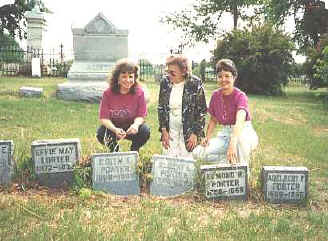
Naomi Hoppe at the graves of her ancestors Jeffrey and Ellis
Finding your parents’ names on that record raised new questions because they were listed as “residents of Michigan.” Residents of Michigan? How come I had never heard of them? Why was mention never made of them in the family history I heard growing up? Why didn’t we have their graves to visit along with all the other Michigan ancestors?
For almost two decades we had to say we still didn’t have any idea—and maybe we never would—about how or when you got from New York to Michigan in time to marry George as a teenager. Your family is listed in the 1850 census in Delaware Co., NY, yet Mary Ann Porter reports that you married George in Michigan in 1855. What prompted your parents to migrate westward? Now research into your siblings lives and locations has given us those answers. Apparently your older brother Stephen started it. After eleven years studying and practicing first as a physician and then as a lawyer in New York, he moved to Grand Rapids in 1853. Younger brother John moved there the following year, and of course by 1855 you and your parents were there as well. Your sister Mary was also married in 1855 but still back in Delaware County, NY. However, her two boys were born in Walker Township outside Grand Rapids in ’57 and ’58. It makes me smile to realize that, in the end, the move to Michigan appears to have been a whole-family affair. We knew from your headstone that you were born in 1839, but that was
all. I wanted to know your birthday! I had to wait a long time, but now I
believe I have it. Your death record said you died on November 2, 1882, at age
43 years, 3 months, and 1 day. That would seem to make your birthday August 1.
Can you believe that is the very date on which my first grandchild was born in
1993? I haven’t been able to locate a record of your marriage to find month
and day. If it was after August 1, you were sixteen. If it was before, you were
only fifteen. The following year, 1856, your first baby, Adelbert, was born. His
headstone tells us that his middle initial was “F.” Was his middle name
perhaps “Ford,” like his father’s? Sometime in 1857, Adelbert died. Since we have only years for these
events (no months or dates), we have no way of knowing whether he was only a few
months old or perhaps had lived well into his second year. (A search at the Ottawa
County Courthouse, where the death records on Delilah and the later infants were found,
yielded nothing on the first three babies Delilah lost. Many records were not officially
kept until 1865.) Whatever, you buried him in a cemetery called Lisbon on 12 Mile Road. Did George
make the casket? How many family members gathered with you that sad day? Were
your parents there and George’s—Curtis and Hannah? With the
transportation of that day making distances much greater, I have a feeling
funerals may not have been as much “family affairs” as they are nowadays. On one visit to Lisbon
Cemetery
I
made a count of how
many other graves were already there in 1857 when you left your first child
there. There were only about twelve. Mary Ann tells us that 1857 was the year George bought that 80 acres of “prime” Michigan land. He began what would be several years’ work to turn it into a fine homestead. The first step to that homestead must have been a basement, and a most outstanding feature of that basement is its massive stone walls. Because we are told that your father-in-law, Curtis, was stone-mason, we suspect that he undoubtedly had a hand in the building of that basement (White House) . In 1858, your grief was somewhat abated as you welcomed a new baby and
named him Edmond (perhaps you were already pregnant when Adelbert died). But,
alas! before long your joy must have been crushed by disbelief as baby Edmond
died, too (in 1859). Though infant mortality was more common in your day than
now, I’m sure that never made it any easier for the mother—especially a new
mother as young as you were. At the end of December in that same year that Edmond died, a third
son was born. You and George named him Eugene. Undoubtedly you worried a lot
about losing him, too—but you didn’t. He would be your first child to live
to adulthood. The Civil War broke out in 1861. For a while I naively imagined that,
way off in Michigan, it didn’t touch you very much, but we now know that it
affected your family very personally. Your brother Stephen, twelve years older
than you, joined up early in the war, rose through the ranks eventually to
Brigadier General, was wounded and returned to Michigan, but three months later
was again leading his regiment in battle. His wound, not fully healed, “broke out
afresh,” and in the end led to his death some eighteen months after being
wounded. In the course of the war, Stephen met personally with President Lincoln
and pled successfully for the death sentences to be rescinded for two of his
regiment. During that interview Stephen’s only surviving child, your nephew
Alexander, ended up on Lincoln’s lap. Don’t ask me what five-year-old
Alexander was doing with his military father in Washington, D.C. during a war,
but surely that story was told and retold in family circles back in Michigan?
However, it did not make its way through later generations to me. I had to learn
it through the Internet. A bit more of that story, in Alexander’s words: “Father told him that I was one of his young soldiers and that I knew the manual of arms, so the President handed me a cane and I went through the manual for him…. Later, I became acquainted with his two sons, Robert and Tad Lincoln, and used to play around the White House with them ...” According to Mary Ann Porter’s
account, 1861 was also the year that George, “by courage and tireless
industry,” had sufficiently developed that “piece of wilderness into a
beautiful farm home” for your fledgling family to move in. Let’s talk about
that magnificent house for a minute. What condition was it in (how well
finished) at the time you moved in? Judging by its size, I suspect it may have
taken many years for George to build it to its current size. I try to picture
life for you in those days—scrubbing your clothes on a washboard, sewing your
family’s clothes by hand, preserving enough of the summer’s bounty to keep
your family alive through the winter, spending evenings with only the light of
candles or kerosene lamps. If I were to describe my life to you, you would not
be able to picture or even imagine it. So there you were, turning just 21 that year, having already buried two
babies in Lisbon Cemetery on 12 Mile Road, with a two-year-old boy toddling
around. When you moved into the house, you may well have already been pregnant
with Elbert, your fourth son, who was born in 1862. How it must have broken you
mother’s heart and George’s, too, when you had to make yet another
trip to the cemetery so soon after his birth! (within the same calendar year, so
Elbert, at least, we know never saw his first birthday). And before long, you were pregnant again. On June 20, 1863, your heart must have been thrilled with the birth of a baby girl, whom you named Mary Ellis. For so long we didn’t know that your mother was still alive and likely near enough to enjoy her namesake granddaughter. With three of your four babies already in Lisbon Cemetery, how you must have lived on tenterhooks wondering when or how something might happen to her, too! Your mother Ellis and your sister Mary Ellis would have been pleased to know that a granddaughter of the first Mary Ellis was also given that name. But the months slipped by, one after another, and she was still with
you. She made it through the winter. And then, lo! she celebrated a birthday,
and then one year became two. In the process, you apparently enjoyed your first
year since being married—perhaps even two—without pregnancy. I’m sure you
loved and treasured your babies, but just as sure that those couple of years
must have been an interlude of relief for you—no pregnancy and no babies
dying! The Civil War ended that spring of 1865, and late that summer you became pregnant again. What did you think about through those long winter nights as you awaited the birth of your sixth child? Baby Ferdinand came into the world on May 29, 1866—and he did not die! ( I did not learn the May 29 part of that date until 1994, at the same time I learned Delilah’s birth date.) Finally you found yourself with as many living children as dead ones. Eugene was seven that year and Mary just turning three. The following year, in 1867, George’s brother Robert died. He was only 44 years old, and he left a family of eight children. How was your strength holding out at that point? Were you glad, or
dismayed, when the winter of 1867-68 found you pregnant again? On May 10, 1868,
your seventh baby was born, another little girl whom you named Edith. I can
imagine how delighted five-year-old Mary must have been to have a baby sister! But the joy was short-lived. Was Edith sickly all that summer, or was it
something sudden when she died on August 13? (Her death record does not list a
cause.) A fourth heart-breaking trip to Lisbon Cemetery. Now it wasn’t just
you and George and grandparents to grieve. Eugene and Mary were old enough to
share your grief. You had just turned twenty-nine that month, and you had been
married thirteen years. I feel sure that by then all
the emotional and physical stress was beginning
to take a toll on you. After little Edith’s death, it was three years before
you were pregnant again. Your eighth pregnancy, and at least your fourth through
a cold Michigan winter, stretched on until June 6, 1872, when little Effie May
joined your family. Eugene was a half-grown boy by then, and Mary was nine. What
a little mother she must have been to her baby sister all through that summer! In August, however, you suffered the loss of your 74-year-old father,
Jeffrey Clarke Champlin. He wasn’t buried at Lisbon, but near Stephen’s
grave in the Fulton Street Cemetery in Grand Rapids. That September, the three
older children were likely attending the school house
just down the road from
you When the school day ended, did Mary hurry little Ferd along on his
six-year-old legs as she rushed home to be with the baby? If so, it couldn’t
have happened very many times before September 19. On that day little Effie May slipped away, too (no cause of death listed
for her either). Is she the baby Mary told her granddaughters Mary Ellis and
Jean about? She said she was present when one of the babies died, that you were
sitting holding (rocking?) the baby when it stopped breathing. Her motions in
the retelling suggested you were holding the baby up in front of you, perhaps
shaking her to get her to breathe. No CPR or 911 in those days. I wonder if the
problem wasn’t “croup,” that old-fashioned term that seemed to take in
most respiratory problems, especially in children.
And so you buried Effie May beside her four tiny siblings. How did this
additional loss effect your three surviving children? Did George’s nearly
80-year-old father Curtis make it to the cemetery that day? What about Hannah
and Ellis, the two grandmothers, ages 72 and 68? As you stood there, did you try
to picture a tall, sixteen-year-old Adelbert standing beside you, instead of
lying all those years small and cold beneath the sod? I am sure you grieved
afresh for him and each of the others in turn. What I don’t know is whether
you felt free to let your tears flow. So there you were, thirty-three years of age, married more than half
your life, with eight pregnancies, five babies in a row on 12 Mile Road, and
three children to raise, ages 6-12. You didn’t know it, but in God’s
providence, you had just ten years to live. The next one to be laid to rest
beside your babies in Lisbon Cemetery would be you. In the meantime, however, you had ten years with neither pregnancy nor
children dying. Were they good years, watching your three children grow, seeing
Mary become a young lady and Ferd a teenager? Or were they hard years because
your health was already wearing down? Probably both. I can’t imagine there was
anything easy about them, with washing clothes by hand, cooking and canning, and all
the rest necessary for the survival of your growing-up family. Those were also years of loss. In the fall of 1873 your mother and
George’s father died within a month of each other. Hannah died in 1878. You
and George buried his parents at Lisbon, too, leaving space between the babies
and them for you and George. Your sister-in-law, George’s half-sister, Betsey
Bennett, died in 1874. We don’t know where Curtis and Hannah lived in their
later years, nor where George’s brothers and Betsey lived. Since the parents
were buried with George’s family, I can’t help wondering if they were closer
to George than to the others, at least geographically. I’ve wondered if they
might have lived with your family in your sizable homestead, but I think if that
were the case, Mary Ann Porter would have mentioned it. How must you have felt when during the winter that you were forty-two, you learned that another baby was on the way? Was it a difficult
pregnancy? I suspect it was. The emotional stress—the possibility of losing
another baby—must have been intense, in addition to the physical strain of yet
another pregnancy. Baby Charles Glenn was born on a fall day in late September 1882 (the
25th). How ironic that, after the deaths of five
babies, this baby would live, but you
would not. When he was less than six weeks old, you gave up your earthly
struggle and slipped away. Your death record says you died of “heart
disease,” whatever that meant in those days. And so, on a day in
early November (you died the 2nd), you made your last trip to Lisbon Cemetery,
this time to rest beside your five babies. Though seven years older than you,
George would not join you there for another 26 years. Your three oldest children were grown or nearly grown by then—Gene,
about 23; Mary 19; and Ferd 16. Mary’s descendants report that at the time of
your death she was engaged to be married, but she postponed the wedding in order
to take care of her infant brother. She did not in fact marry until July of 1884
when she was 21, several months after George married Mary Ann Batson in February
of that year. Eugene married in March that same year but Ferd married
six years later in October 1888. I can’t close without mentioning
that Ferd cared so much about you that—much to her dismay—he gave his
daughter your name. Though she always went by Fern Delilah, or Fern D, I now
know that her given name was Delilah Fern. She was never fond of the name,
undoubtedly because of its biblical connotations. Perhaps if she had known you
and had had a special relationship with you as her grandmother, it would have
made a difference. But with your having been gone already a dozen years when she
was born, you were not surprisingly nothing more than a name—a name she never
learned to appreciate. I wonder if you and she have had any conversations about
that in heaven...(The same thing happened with Eugene’s daughter, whom he named Delilah Zoe but who went through life as Zoe.) Well, Grandmother, I’ve rambled long enough. I do look forward to meeting you in heaven some day. My closest link to you is that I sat on your son Ferd’s lap (see picture) when I was a year old (but otherwise never knew him). He and his daughter Fern (my grandmother), and even my mother (Fern’s daughter) have joined you there. It hasn’t been too hard coming to grips with the fact that I am just a link in a chain. The births of my grandchildren* over the last decade helped to clothe that in reality. Maybe earthly relationships won’t be important when we get to heaven. Okay. But I am glad I will have done what I could to make you and others ahead of us in the chain a little more real to those who come after.
Your great-great-granddaughter,
*In 2006 I had the pleasure of taking those grandchildren of mine to your family graves in Lisbon Cemetery, and they even got to go into your home. In later years some of my sister’s grandchildren and a few other family members as well have been able to spend a few minutes in your home. That still amazes me. |
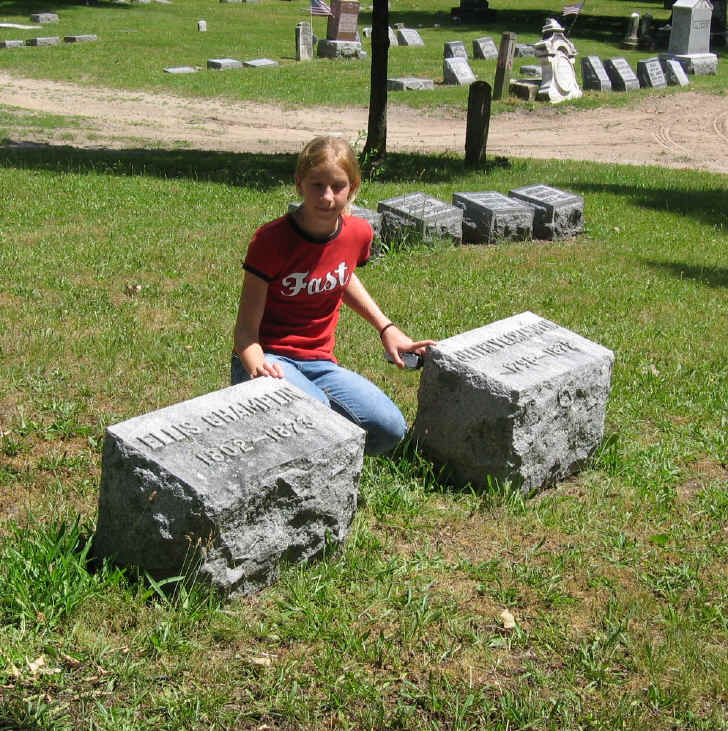
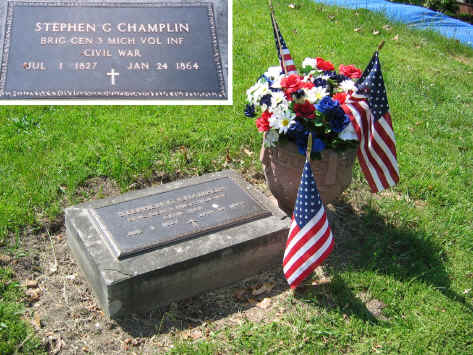 It turns out they are buried in the Fulton Street Cemetery in Grand Rapids, and in April 2002 and several times since then I’ve had the satisfaction of visiting their graves near that of their son and your uncle Stephen Gardiner Champlin. The truth is, your parents were gone almost twenty years before your granddaughter Fern came along, and your parents were buried in town more than twenty miles from the North Chester area. Not only Fern’s grandparents but even her other
great-grandparents lived and died within sixteen miles of where she grew up. With transportation still in horse-and-buggy stage during her childhood, visiting the graves of those she had known and who were buried nearby became a lifelong custom, but apparently not regarding your parents, the Champlins, because she never knew them and they were buried some twenty-five miles from North
Chester.
It turns out they are buried in the Fulton Street Cemetery in Grand Rapids, and in April 2002 and several times since then I’ve had the satisfaction of visiting their graves near that of their son and your uncle Stephen Gardiner Champlin. The truth is, your parents were gone almost twenty years before your granddaughter Fern came along, and your parents were buried in town more than twenty miles from the North Chester area. Not only Fern’s grandparents but even her other
great-grandparents lived and died within sixteen miles of where she grew up. With transportation still in horse-and-buggy stage during her childhood, visiting the graves of those she had known and who were buried nearby became a lifelong custom, but apparently not regarding your parents, the Champlins, because she never knew them and they were buried some twenty-five miles from North
Chester.