THE BRICK HOUSE ON 16TH STREET
Ferd and Esther Porter spent the last several decades of their lives on the farm on 16th Street outside of Conklin, Michigan. More than a century after it was built, the house is still there and is in use as a family farm home.
|

|
|
|
The farmhouse when it was quite new, abt. 1899 |
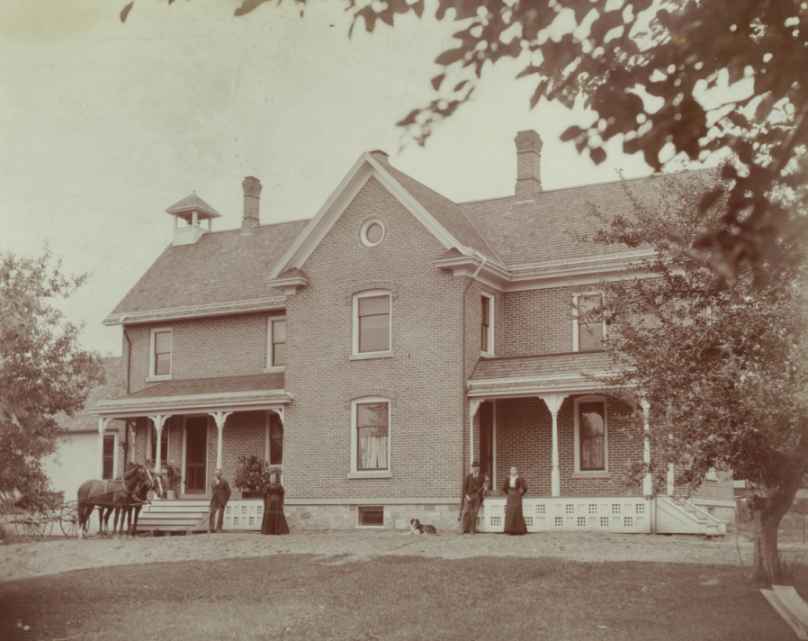
We have a real treasure in a large picture of the house, apparently taken formally when it was quite new and splendid, showing two couples standing in front. Because we have other pictures of Samuel and Roxy Stauffer, we believe they are the couple on the left. That would mean the picture was taken before Samuel died on the property in late 1899. We find it interesting that they wanted the family dog and their horses and buggy included in the picture. And those of us into flowers around the home take happy notice of the plants on the back porch.
Given what we know from Forrest's journal, that Mabel and Harvey lived in the house at the time of his birth and following, we believe they are the other couple in the picture. All this allows us to make a pretty sure assumption that Mabel was the daughter mentioned in Samuel's obituary, the one who helped her mother get her father's body out of the well.
1992
FAMILY
TOUR
On June 25, 1992, Porter grandson Lyman Wood was one of a family group who made the rounds of several family history sites in the North Chester area. Lyman remarked in advance that he “had a mind to knock on the door of the brick house and introduce himself.” As it turned out, he didn't have to knock because the current owner and his sons were outside repairing the back porch.
The owner was most cordial, inviting family members to look around, answering questions, and recounting the story of the man who “died to save another” (Samuel Stauffer). He brought out a stack of black and white prints, several inches thick, of family pictures which his family had had made up from glass negatives found in the attic when they purchased the house. He said that Forrest Averill (d. 1986) had come by once and written identifications on as many pictures as he could. The owner also pointed out where the last of Ferd’s barns had recently been torn down.
The
1992 owner, who told us he owned 1200 acres of fruit trees in four adjacent
counties, even invited family members into the house. We were able to
stand for a few moments in the “two-egg” kitchen (see Ferd & Esther Porter
history) and imagine all the decades of family life that had happened there.
THE
YEARS BRING CHANGES
 |
|
 |
|
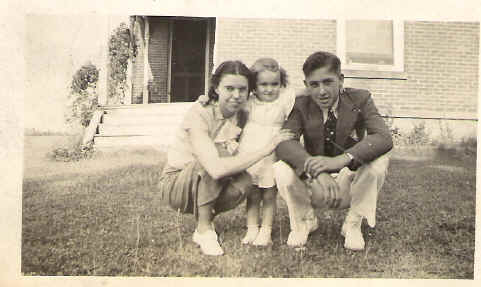
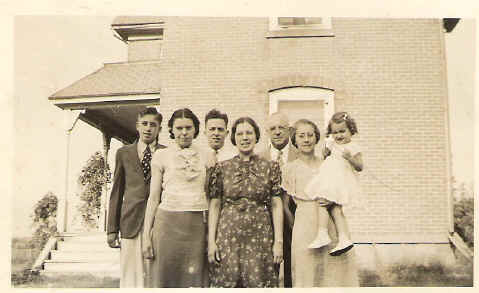
The house is seen in a number of pictures throughout the Hawkins photo albums
which have come down through the family, some with people and some without. The
two here must have been taken in the summer of 1938 shortly before Porter
granddaughter Esther and husband Virgil set off with Esther Joanne for their
second term in Africa. It was undoubtedly a trip for them to say goodbye to
"Grandpa Porter."
And a final goodbye it turned out to be. Because of World War II, the Moneysmith
family
would not return from Africa for seven years. Grandpa Porter (Ferd) would die seven months before
our return. By that time, the house had been emptied of family possessions (except for those forgotten glass photo plates in the attic and possibly
the Stauffers' huge Bible) and
sold. I have no doubt that not long after our arrival we
made a "pilgrimage" with Grandpa and Grandma Hawkins up to Michigan to
drive by the house and visit Bennett cemetery where the Porters are buried. (I remember several
such trips through the years, but they all run
together in my memory.)
I regret I wasn't old enough that day, nor had enough understanding of family
history yet, to realize how hard it must have been for my mother. It wasn't just
that her grandfather was gone, but the house was no longer in the family and she
would never step inside it again. I like to think it would have been a comfort
to her to know that, amazingly, fifteen months after her death, I would
have occasion step inside it briefly.
[1] Ford Porter, son of George born is 1893, is quoted as saying he lived in the white Truman Road house until he was “8 or 9” (i.e., 1901 or 1902), and then [George] built the brick house and they lived there for several years. This does not fit with the fact that we now have solid information that Samuel Stauffer owned the brick house when he died on the property in 1899 and that his widow and daughter's family lived there until 1908 when the house went to another daughter and her husband.