FERD W. PORTER and ESTHER STAUFFER(1866-1944) (1868-1930)
Ferd Porter was born the year after the end of the Civil War and the assassination of Abraham Lincoln. He was born into a family where three of the first four babies had died within a year of birth. When he was born, his parents had been married eleven years. He was his mother’s sixth pregnancy (she was 27), but there was only one living brother, Eugene, aged 6, and a sister Mary, age 3. The family lived
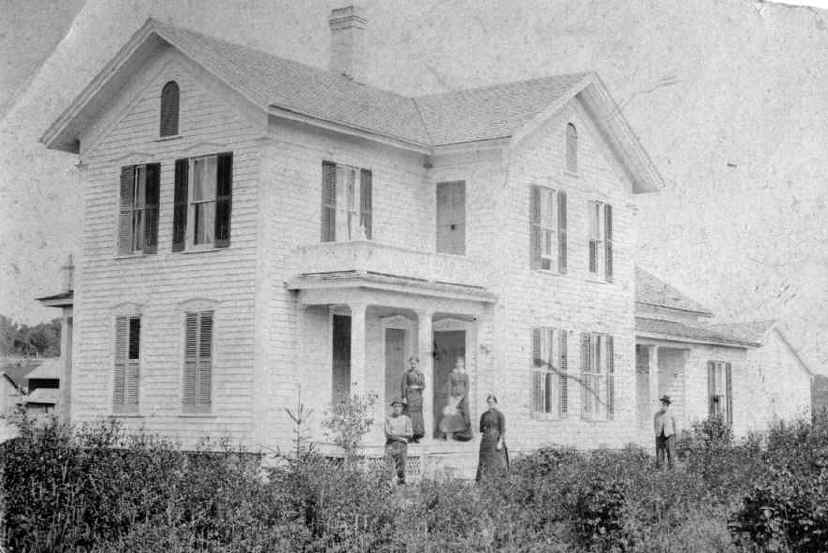
in a large frame house which his father George had built just a few years
earlier. Indeed, additions and improvement on the home may well have been
ongoing throughout Ferd’s childhood. George was a farmer, and Ferd would have
grown up learning and sharing in the farm chores from a young age. When Ferd was
two, a baby sister, Edith, was born and but she died three months later. When he
was six, the same thing happened with yet another, Effie May. Then for ten years
there were no babies. When Ferd was a teenager, however, another baby brother
was born, Charles Glenn (who went by Glenn). Family tradition says that Delilah,
by then past forty, never fully recovered from the birth. On November 2, 1882,
when Glenn was six weeks old, the
mother of the family died. MARRIAGE
A year and a
half later, Ferd’s father remarried. Ferd himself did not marry for four more
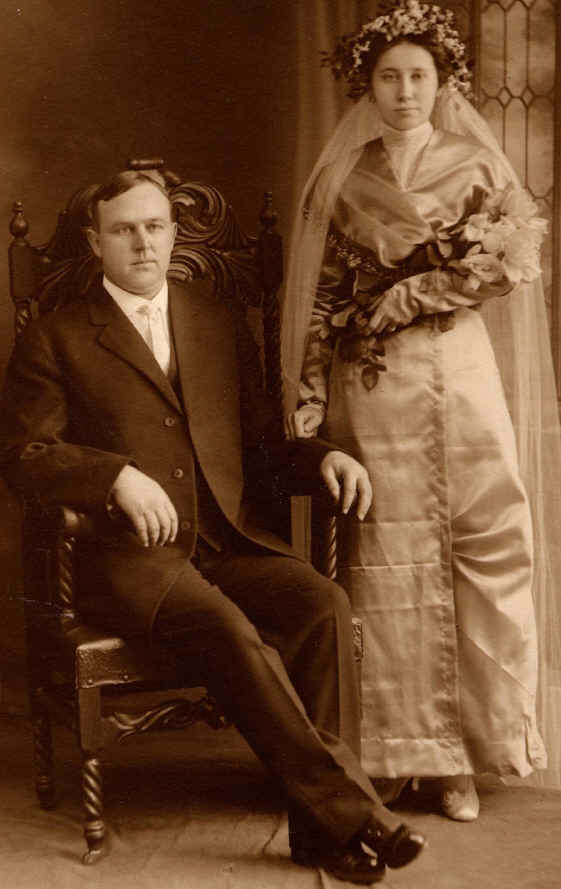
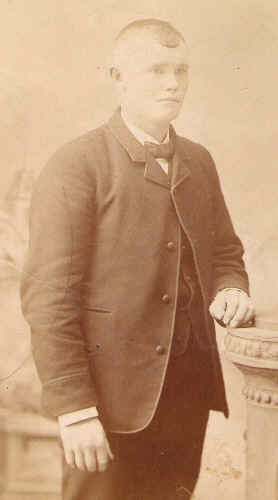
years. He was 22 when he married Esther (occasionally called Ettie) Stauffer. We
know little or nothing about him in those years between his mother’s death and
his marriage, whether he continued living on his father’s farm, got into
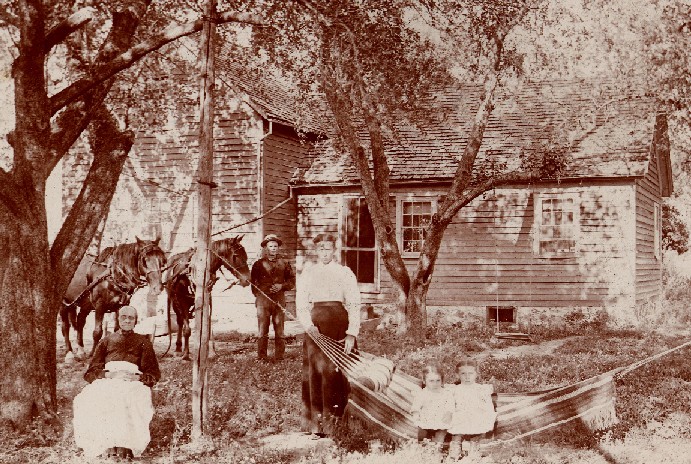
farming on his own, or what. He is
seen in the yard in a picture of the home taken when Glenn was small and Ferd was perhaps 18. Esther Sophronia
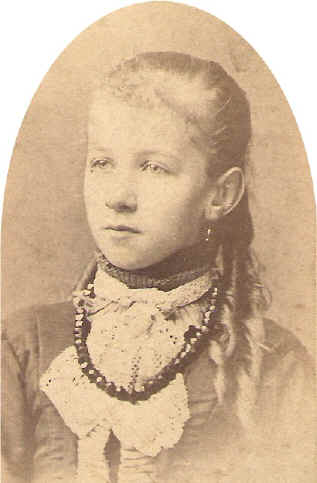
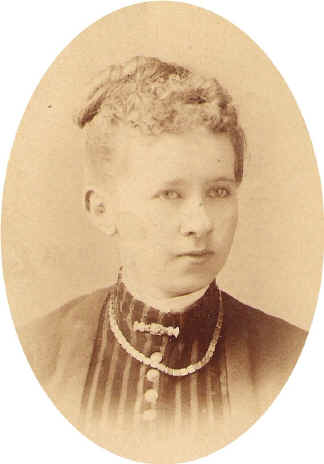
Stauffer was the second child of Samuel and Roxana (Wells) Stauffer (see Samuel
Stauffer history). She was
probably taking her first steps hanging on to the furniture when Ulysses S.
Grant was elected president. Her brother Charlie was two years older. She was
eight when her brother Frank was born and 12 when her sister, Lois Mabel, was
born. Undoubtedly, Esther enjoyed having a baby sister to mother. An autograph
book, given to her the Christmas she was eleven, survives in the family and
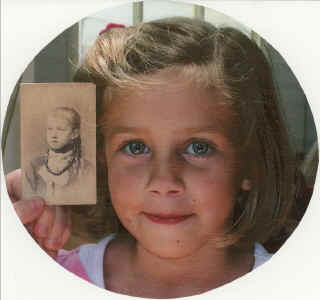
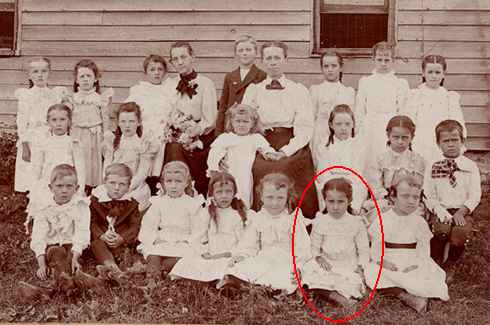
makes delightful reading. A picture taken in 2006 won a prize in the genealogy Family Tree Magazine. It showed a surprising resemblance between the child Esther Stauffer and her fourth-great-granddaughter, Victoria Caroline Gross, born 132 years after Esther. Ferd and Esther
were married October 24, 1888. The two family members who signed the wedding
license were Esther’s mother, Roxy, and her brother, Charles. Samuel’s
younger brother George would later marry Roxy’s younger sister, Mary Jane.
They had five children, including twins Claude and Maude, before George came
home early one day and found Jane in a “compromising situation.” There
was a divorce. George remarried and had a son, Earl, whose wife, Ruth, was such
a help in our earliest gathering of information on the Stauffers.
Two years later,
a baby girl was born to them whom they named Effa Mildred. An unusual family
situation was taking place during those years because Ferd’s father, George,
was also having children. When Effa was eleven months old, her “aunt,” Mila
Hazel, was born to George and Mary Ann Porter. On February 5, 1893, when George
was sixty, his twelfth child, Ford, was born; a year later, on February 2, 1894,
a baby who was Ford's niece was born to Ferd and Esther
SPECIAL
PICTURES
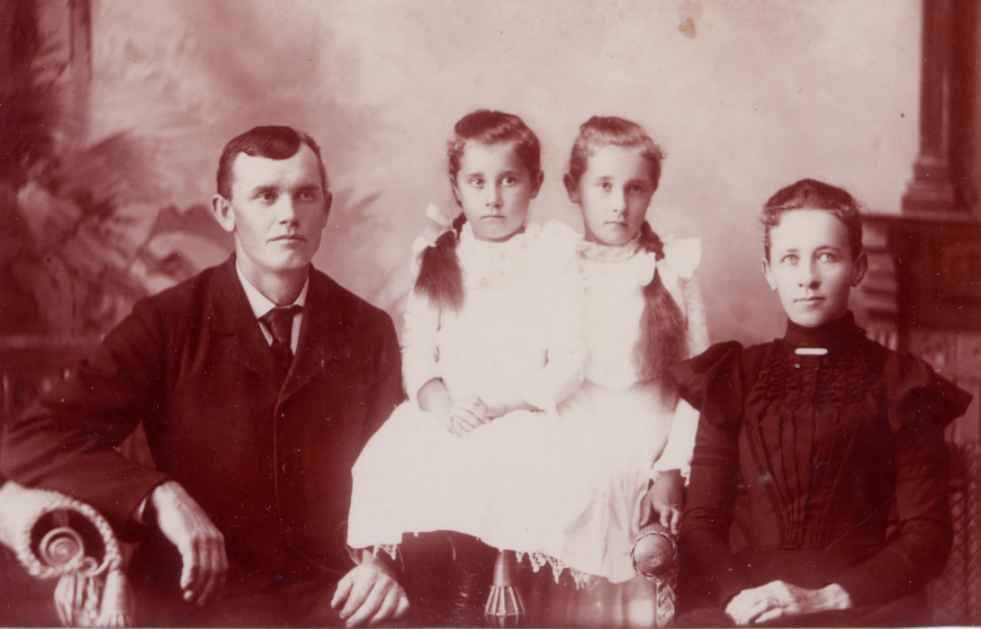
Another picture
of the young Porter family came to us through Jean VanderLaan Haas, a
granddaughter of Ferd’s sister, Mary. It shows the family in a more
formal setting and the girls a little older. In this picture it is hard to tell
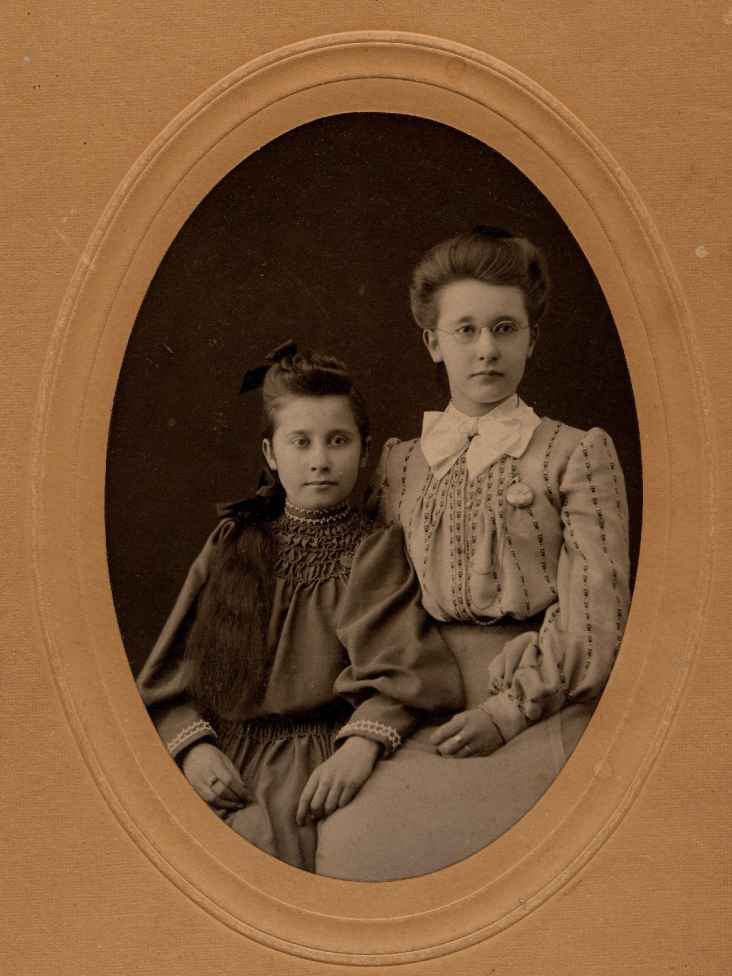
which sister is older, but closer examination shows that Fern is sitting on a
stool. In the later picture of the two sisters below, Effa is clearly four
years older than Fern.
Nine years after
Esther's father died in a cistern accident on his farm and a year before her
mother died, mother Roxy
Stauffer's estate was "settled," and Ferd and Esther became owners of
the farm. They and the girls moved to the brick house. In 1908 Ferd’s father, George, died, and in 1909 Esther’s mother,
Roxy, died. Ferd would live in that house some 45 more years until his own
death. EXPANDING FAMILY The year after
Esther’s mother died, 1910, began an eventful decade for Ferd and Esther. In
October, 20-year-old Effa married—on her parents’ 22nd
anniversary. Two years later, Ferd and Esther welcomed their first grandchild, a
baby girl whom Clyde and Effa named Helen. At the time, Clyde was studying at
Moody Bible Institute in Chicago. Meanwhile, a new
pastor, freshly graduated from Moody, had come to the North Chester Baptist
Church. The story goes that he boarded with the Porters for a while. This was a
common practice in those days, and after all, their brick house was just down
Sixteenth Street and visible from the church. It wasn’t long before the
minister, Mont Hawkins, had fallen in love with the Porters’ younger daughter,
Fern. A priceless
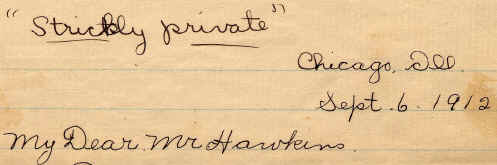
treasure has survived in the family--a letter written by Fern to Mont in 1912
when she was visiting her sister in Chicago. In deference to her wishes about
strict privacy <smile>, we are going share only a couple of choice
sentences. Despite the formal (to us) salutation,
it is clear in the letter that the two were in love. She says on the first
page,
"My dear, I am so glad you told the
folks, I thought about
it this morning and wondered if you had yet. I am so anxious to see you and find
out all about it. You don't know how much I miss you." Mont and Fern
were married
in December of 1913. November of 1914
brought a second grandchild, Lyman to Effa, and January of 1915, a third, Esther
to Fern. Agnes was born to Fern in 1917 and Leon to Effa in 1918. A last
grandchild, Paul, was born to Fern in 1921. The Industrial Revolution was
beginning to be felt in family dynamics. With both sons-in-law being pastors,
the grandchildren did not live in the immediate vicinity, as had those in the
preceding couple of generations. PORTER REUNIONS
The 1920s saw
the beginning of Porter Reunions. These were attended by descendants of George
Porter’s father, Curtis. All five of Curtis’s children had found their way
to Michigan from New York. At the first reunion, George’s widow (Ferd’s
step-mother and one of the matriarchs of the group in attendance) was
commissioned to write a family history. From that we have learned a great deal
about our Porter ancestors. A notebook was kept of the reunions. Once they began
a “sign-in,” we can tell by their signatures that Ferd and Esther’s family
were quite faithful in attendance, sometimes coming from as far away as northern
Indiana. The reunions were held almost until the time that World War II broke
out. FAMILY STORIES The family
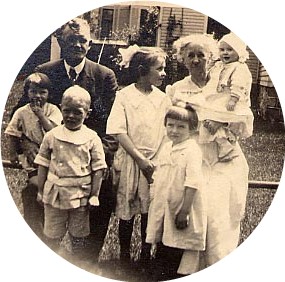
enjoys a number of stories about our Grandma Porter. Once a visiting preacher
stayed with the Porters while conducting meetings at the North Chester Church
(after all, they lived just up the road, within sight of the church). For some
reason, when the meetings were over, the preacher did not leave. Every morning,
Grandma Porter faithfully served him an egg (and whatever else) for
breakfast—and the next morning
he was always still there. Finally one morning she served him two eggs.
“Oh!” he
said. “Two eggs! Is there some special occasion?”
“Why, yes,”
she replied demurely, “you have a long journey ahead of you today.” Some
family members still joke about serving two eggs on days when someone is going
to travel.
In the early
twenties, son-in-law Mont Hawkins’s pastorate took the family to northern
Indiana, which was some distance from North Chester in those
transition-from-horse-and-buggy days. Some time later, Mont acquired a car
(perhaps the first in the family?) and proudly drove his young family up to the
farm in it. On arrival, he couldn’t help bragging that they had traveled thirty
miles an hour on the trip up, to which Grandma Porter exclaimed, “My word,
Mont! You’re gonna kill ‘em all!”
Apparently
Grandpa Porter decided that was one joke that needed a turnabout to make it fair
play. The next time the grandchildren arrived at the farm, he made an offer he
knew they wouldn’t refuse. Knowing that his city-dwelling grandchildren loved
nothing more than buggy rides when they visited the farm, he offered them one.
With great anticipation, they trouped after him out to the barn and waited
impatiently while he got the faithful horse all bridled and harnessed to the
buggy. The children
piled in and got settled, and Grandfather took his seat. But instead of ordering
the horse forward, he suddenly said, “April Fool!” Someone produced a camera
and documented the occasion of “Grandpa’s revenge” for the family album,
but it is too small for the passengers to be identified.
At one time in
the 1920s, Ferd and Esther left the farm in the care of their son-in-law Clyde
Wood and his family while they spent several years living in Mishawaka where
Mont was still a pastor. There Ferd took up home building. He built four houses,
including the one at 1012 Charlotte Street in which daughter Fern and her family
lived for the next 25 years and where she died. It was also the home that her
missionary grandchildren would come to know as “Grandpa and Grandma
Hawkins’s house.” Even now, some eighty years later and in the next century,
family member still occasionally drive by the house when they are in the area.
CLOSING DAYS
In the fall of
1930, Esther was discovered to have cancer of the stomach. Surgery was
performed, but in those days with no other treatments available, it was too late
to do anything but close her up again. When they laid her to rest one day in
mid-October (she died the 16th), who would have guessed that the 15-year-old
granddaughter in the group, her namesake Esther, would die on her grandmother's birthday 61 years later—also from a stomach
problem.
Ferd lived
another fourteen years. Though he and Esther had attended nearly all the Porter
reunions, including one just six weeks before her death in 1930, he apparently
never attended another. The reunion book, however, records his marriage on May
26, 1935, to a widow named Etta VanderHoof. Lyman Wood remembers her as being
“one of the sweetest women” he ever knew.
Born a year
after the close of the Civil War, Ferd lived to within six months of the end of
World War II, in which his grandson Paul fought. He died, also from cancer, the
last winter of the war (December 14, 1944). He actually died during the
Battle of the Bulge in which Paul was fighting. In the fourteen years between
Esther’s death and his own, five of his six grandchildren married, and he had
the pleasure of seeing six great-grandchildren—Esther J. Moneysmith, David
Gordon, Barbara, Tom, and Dan Wood, and Jim Wood. Three others he did not see
because they were born overseas to his missionary granddaughters—Don and
Dottie Moneysmith to Esther and Ruth Anne Divine to Agnes. Within eight years of
his death, both his daughters joined him in glory. Within twenty years, one of
his granddaughters and three of his great-grandsons did also (Helen Wood Gordon,
David and Mark Gordon (March 26, 1959) and Don Paul Moneysmith (March 5, 1964). |
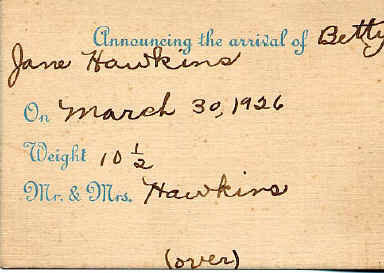 One
spring, also in the twenties, the Hawkinses sent the Porter grandparents a baby
announcement, which survives in the family archives. It recounts the birth of
“Betty Jane” and gives all her vital statistics. Grandpa Porter is reported
to have grunted to his wife, “My word, Mother—did you know anything about
this?” Then he turned it over and discovered “April Fool!” penciled in
tiny letters in one corner.
One
spring, also in the twenties, the Hawkinses sent the Porter grandparents a baby
announcement, which survives in the family archives. It recounts the birth of
“Betty Jane” and gives all her vital statistics. Grandpa Porter is reported
to have grunted to his wife, “My word, Mother—did you know anything about
this?” Then he turned it over and discovered “April Fool!” penciled in
tiny letters in one corner.