My original write-up on Abraham and Magdalena Stauffer was pitifully short, just one page. After learning what we did from Ezra Eby, I set out to expand the write-up. In the process, I gained access to some new sources and did a lot of sleuthing, processing, and calculating. The result? Three pages on Abraham and Magdalena and three new write-ups tied to our ancestors and their family members who moved from Ontario to Michigan. All this time, we had a mystery involving Abraham’s five children by his first wife. Now that we have finally solved that mystery, I can expand on the life stories of Abraham and Magdalena even more seriously. Abraham's FamilyAbraham G. Stauffer was born in September 1814 in Ontario, Canada, nine years after his Grandfather Abraham had moved his family there from Lancaster County, Pennsylvania. Abraham was the sixth of the eleven children of Samuel and Esther Groh Stauffer. Those six included a set of twin sisters, and the oldest of the six turned just seven the month Abraham was born. Mother Esther clearly had her hands full. The next five would be born over a span of ten years. This wasn’t the only prolific family among the Stauffers; Abraham grew up with more than thirty first cousins around. Both his mother's and his father's families had migrated from Pennsylvania when they were young. His grandfather Michael Groh had died on the journey shortly before his family's arrival. Young Abraham was nine when his Grandfather Abraham Stauffer died. When Abraham was 21, he married a girl named Susannah Latschaw, born in 1812. According to Eby, she was the third of eleven children. We don't have much information on her marriage to Abraham except that it produced five children over a span of eight years. There were two boys (Isaac and Jacob) and three girls (Esther, Mary, and Susannah), born every other year from 1835 to 1843. Our Stauffer booklet (Early Stauffers) then told us that in 1843, the year the fifth child was born, Susannah died of hydrophobia, which usually means rabies. Mysteries of the ChildrenGiven that number of small children, we weren’t surprised that Abraham remarried within a year, but for nearly thirty years we wondered what happened to the children of that first marriage. We assumed and even reported here that Magdalena took on five stepchildren, soon followed by a baby of her own. We searched fruitlessly for them in our sources such as Eby, the Stauffer booklet, and information from Jo Kelly, who has worked on a detailed history of Chester Township. Among other things, we could find no record of Susannah’s children going with their father when he migrated to Michigan ten years later. Despite the childbearing history of our ancestors George and Delilah Porter (Letter to Delilah) and of Abraham’s aunt (Esther Stauffer Clemens), with no reports to that end we never seriously considered that they might have died. And that many of them? But now in 2014 and 2015, we have some solid information: Nothing more on Isaac, the firstborn, suggesting he lived only long enough to be named. The record then reports Esther born in 1837 and dying in 1838 and Jacob born in 1839 and dying in 1840. The fourth child, Mary, apparently lived somewhere between two years and three years (1841-1843). So all four of these children born to Abraham and Susannah died in infancy or very young. We still have a mystery about the fifth and youngest child, Susannah, born the same year her mother died. Records tells us she was married in Waterloo, Ontario, in 1863 when she would have been twenty. That means she not only survived to adulthood but apparently did not accompany her father Abraham when he moved his family to Michigan when she was eleven. We toyed with the possibility that Susannah’s maternal grandparents might have taken her after their daughter’s death and before Abraham’s remarriage to Magdalena, but a check of dates shows that Susannah’s mother, Maria, died when Susannah herself was four. However, we know from Eby that our Abraham’s Susannah had two older sisters who were already married and had children; it seems possible that one of them took the baby and raised her in her own family. What we do know is that the child Susannah married Henry Whitmer and that their first three children were born in Waterloo in 1864, 1867, and 1870. The fourth (1876) and fifth (1880), however, were born in Michigan—but in Burnside, Lapeer County, which is in a different part of the state from the area where Abraham went. If this is indeed the child of our Abraham G. Stauffer, then her father had died between the births of her first and second child and she was still in Canada. Lots of speculation, but we know more that we did before about this child of our ancestor. All this about Susannah’s children strongly affects the history of our ancestor Abraham. We pick it up with his second marriage MagdalenaFor fifteen years this account read: “So who was this Magdalena Shupe who responded to the need of that 30-year-old father and at the age of 23 took on five stepchildren, including a baby?” Now we know that instead of stepchildren we have a husband who had already buried four of his five children before they barely had a chance to live and who had watched his wife die a horrific death. Magdalena was born in September 1820, the second daughter of George and Elizabeth (Scheirich) Shupe. For many years George was the Mennonite Bishop in Waterloo, Ontario. Both his family and Elizabeth's had come from Pennsylvania when he and she were children. One grandfather died before Magdalena was born, and both grandmothers died when she was five, but Matthias Scheirich lived until she was fourteen. One of her brothers, Moses Shupe, ended up in Kansas, where he put down roots and raised a family. One of his descendants found me through this website, and we are now friends on Facebook. Back in Abraham’s story, the years 1843 and 1844 were very full ones. During the space of twenty-one months baby Susannah was born, her mother Susannah died, Abraham married Magdalena, and a son was born to her—all by September 30, 1844. That boy baby was named Samuel after his grandfather, and he grew up to be our ancestor who gave his life to save another when he was just 55. Some two years after Samuel’s birth, another son was born to Magdalena. They named him George. In addition to Samuel, Abraham named four of his other sons Isaac, Jacob, Moses, Aaron, and Noah—so how did George get in there? After many chuckles in our family about that, we learned from Magdalena’s death certificate that George was her father’s name. It was a daughter-in-law of George's, Ruth Stauffer in the 1960s, who helped me acquire my original information on the Stauffers. One piece of that information from her was about Moses and Aaron (see below). We didn’t know about Susannah’s children until the late 1980s. The Move To MichiganWhen Abraham was 40, he decided to do what both sets of grandparents and many of their friends had done—pull up stakes and move to another country. In this case, the other country was back to the one his grandparents had left, but an entirely different part of it. We don't have rich accounts of this move such as Eby has provided us on the others, but we have learned that they didn’t do it in isolation (Migration—a Family Affair). We only know that Abraham and Magdalena moved to Michigan in 1854 and that apparently Magdalena was quite pregnant during the trip.
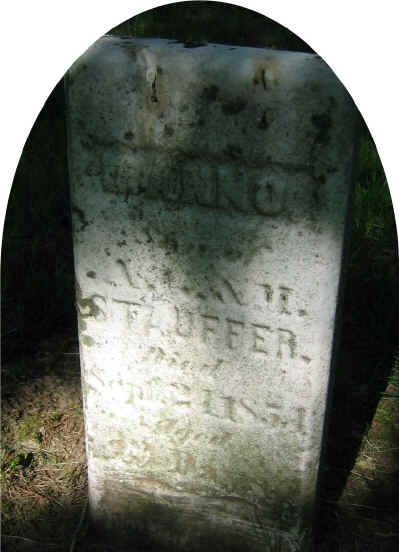
Michigan at that time had been a state for ten years. It had been a political football between the French and the British before being given to the Americans as spoils of war. How much "virgin" land was there to be claimed, we aren’t sure, but we suspect it was considerable considering how the fur trade had thrived before it became a state. For a long time we knew only that sons Samuel, 10, and George, 8, went with Abraham and Magdalena to Michigan, but we now know that they also had three-year-old named Noah. We're fairly sure Moses and Aaron, perhaps born in the interim between George and Noah, had already died. We do know, sadly, that the baby son born that September 1854 and whom they named Manno lived only thirteen days (picture). For many years we did not realize that apparently Abraham did not settle in Chester Township, Ottawa County, until some eight years after his arrival from Canada. It seems he first lived in Gaines Township near Caledonia. His two sisters and their families had been there for some time as well. Read about this in Migration—a Family Affair. Then for reasons we have no clue on, the year young Noah was eleven, Abraham’s family moved from south of Grand Rapids to Chester Township, forty miles away to the northwest of Grand Rapids. That's where all the members of Abraham's immediate family are buried, including a nephew we have only recently learned about. Abraham was in Michigan only twelve years before he died in 1866, two days after his 52nd birthday. Magdalena was left a widow at 45. Michigan didn't start keeping formal records until 1867, so we don't know anything about his death except the dates from his headstone and cemetery records. Magdalena's Later Years
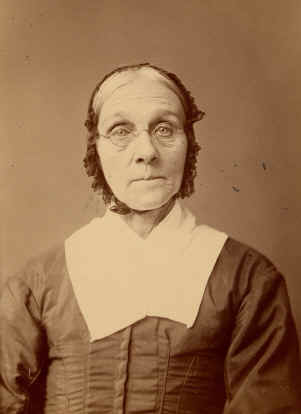
Magdalena lived 35 years after Abraham’s death, until three months short of her 81st birthday—long enough to see the new century. In addition to the deaths of three infants and her husband’s death after 22 years of marriage, she lived to see the death of her 27-year-old son Noah in 1878 and of a 19-year-old granddaughter from tuberculosis in 1888, a son traumatized by his wife's infidelity and divorce in the 1890s, another 19-year-old granddaughter apparently pregnant before marriage, not to mention the traumatic accidental death of her son Samuel when she was 79. In fact, of the six children to whom she gave birth, George was the only one who outlived her. I think she earned the right to look a little stern in that amazing portrait we have of her. That picture is one of two that have survived in the family which we are quite sure are her—that one and one with the family of her granddaughter. In the 1870 and 1880 censuses, Magdalena was listed in the household of her son George, but the picture of the young family of granddaughter Esther Stauffer Porter strongly suggests she was living with them near the end of her life, likely after the breakup of George's family. (It is interesting to imagine the discussions that might have taken place about "who will take Grandma now?") Based of the sizes of Effa and Fern in the hammock, we estimate a date for that picture near the end of the century. Grandson Frank Stauffer’s wife, Emma, recounted that when Magdalena came to their house in 1900 “she would be dressed in a long black dress and her bonnet that she never removed” [quote from first Ruth Stauffer letter, Aug. 9, 1966]. Magdalena died in June 1901. Family TreesAnd so another branch of our family tree ended up in Michigan. It would be satisfying to know Abraham's reasons for moving to the United States since his father and grandfather had abandoned it for Canada. Even more, I wish I knew what took him to Chester Township, leaving the rest of the Stauffer clans behind—but none of that really matters. The important thing is that he ended up where he did because arriving in Michigan the same year as the Stauffers was the Wells family from Painted Post, New York. Their eleven-year-old daughter Roxy would, eleven years later (1865), marry Abraham’s son Samuel. They would name their first daughter Esther, she would be my great-grandmother, and so the chain of generations has continued to roll on. |
|||||||||